
The Reserve Bank of India (RBI) reported a significant 52 per cent year-on-year increase in gains from foreign exchange transactions, reaching 1.69 trillion in FY26. This surge occurred despite the central bank selling a gross $195 billion in the spot market to manage rupee volatility, which saw a 9.85 per cent depreciation.

Tata Consultancy Services (TCS) has launched India's first Oracle AI Data Platform Lab and Centre of Excellence (CoE) in Kolkata, in collaboration with Oracle. This facility aims to help enterprises accelerate the adoption of artificial intelligence and data-driven transformation by addressing challenges like fragmented data and limited AI scalability. The lab will leverage Oracle's AI Data Platform and TCS plans to expand similar CoEs to four more Indian cities.

India's outward foreign direct investment (FDI) saw a significant increase of 27.5 per cent, reaching $7.06 billion in March, primarily driven by a sharp rise in guarantees for overseas units, according to the Reserve Bank of India.

Following the Ebola outbreak in parts of Africa, Indian authorities are closely monitoring the situation and reinforcing surveillance measures to prevent the virus's potential spread into the country. Health experts emphasise the importance of vigilance and preparedness.

Market participants are keenly awaiting regular, preferably weekly, updates from the Reserve Bank of India (RBI) on Foreign Currency Non-Resident (Bank), or FCNR (B), deposits, following the central bank's directive for banks to submit daily data on these inflows.

TVS Venu Group has agreed to acquire a minority stake of up to 9.9 per cent in Jana Small Finance Bank, including a 4.9 per cent ownership by TVS Motor Company, through a combination of primary issuance of warrants and a secondary purchase.

ServiceNow, a leading AI platform for business transformation, is highly optimistic about its growth prospects in the Indian market, according to President and Chief Product Officer Amit Zavery.

Specialty chemicals maker Anupam Rasayan India Ltd has become the first company globally to commercialise Ethyl trifluoroacetate (ETFA) production using its proprietary continuous flow chemistry platform. This innovative technology offers significant advantages over traditional methods, and ETFA is a crucial component for pharmaceuticals, life sciences, and performance materials, with a global market estimated at USD 500-600 million.

Priyanka Chopra Jonas has announced a collaboration with Angelina Jolie while also sharing insights into her role in S S Rajamouli's Varanasi.

Indian benchmark indices Sensex and Nifty climbed in early trade, driven by buying in blue-chip stocks like Reliance Industries and ICICI Bank, alongside a notable cooling in crude oil prices.

The first thing cardholders should do after spotting a suspicious charge is block the card.

Even if there is an early agreement on a cessation of hostilities in West Asia, the price shock will not go away easily, points out A K Bhattacharya.

Tamil Nadu's new government, led by C Joseph Vijay, is committed to advancing the ~38,000 crore shipbuilding project with HD Hyundai in Thoothukudi, securing bipartisan support from the Opposition DMK, despite initial industry concerns about policy continuity after the change in leadership.

Jio Platforms Ltd, the digital and telecommunications arm of Reliance Industries, has received board approval to file draft papers for an initial public offering (IPO) involving a fresh issue of up to 27 crore equity shares. The draft red herring prospectus (DRHP) is expected to be filed with SEBI today, marking a significant value-creation event for Reliance shareholders.

Dabur India's shares rose 3.7 per cent after reporting in-line Q4FY26 results, driven by a healthy 10 per cent growth in its India business, despite some analysts remaining cautious about future execution.

rediffGURU T S Khurana answers readers' personal income tax queries

Bank of Baroda economists project India's GDP to grow 6.5-6.8 per cent in FY27 but warn that the fiscal deficit could overshoot the budgeted 4.3 per cent target, potentially reaching 4.7-4.8 per cent of GDP due to subsidy overruns, excise duty cuts, and oil marketing company losses.

'Mark Mobius's life was dedicated to investing.'

Mukesh Ambani announced a 10 lakh crore investment by Reliance Industries to revolutionize artificial intelligence in India, focusing on building sovereign compute infrastructure and making AI accessible and affordable for all.

"Taxpayers with income from shares, mutual funds, crypto, ESOPs, or derivatives often incorrectly use ITR-1 instead of ITR-2 or ITR-3."

Bihar's greatest resource is not beneath its soil but above it -- its people. With a population approaching 140 million and one of India's youngest demographic profiles, Bihar possesses an asset many societies would envy, explains Bihar Governor Lieutenant General Syed Ata Hasnain (retd).

'It will take a long time to recover from the impact of this war.'

Prime Minister Narendra Modi's visit to Italy concluded with the elevation of India-Italy relations to a Special Strategic Partnership, focusing on enhanced cooperation across various sectors.

Adani Group Director Jeet Adani and Bharti Enterprises Vice Chairman Rakesh Bharti Mittal highlighted the importance of infrastructure, energy, and connectivity in shaping India's AI ecosystem, emphasising Visakhapatnam's potential as a major digital gateway.

Students and families must stress test repayment capacity based on Indian salary standards.

Reliance Industries Ltd (RIL) has expressed caution regarding 'extreme volatility' risks stemming from the West Asian conflict, which could impact global oil demand and the company's margins, while also noting that near-term retail consumption demand may remain sensitive to macro conditions. Chairman Mukesh Ambani, in the annual report, remained silent on the timeline for Jio Platforms' anticipated public listing, stating the group will 'continue to evaluate strategic pathways'.

Billionaire Mukesh Ambani announced that the transfer of day-to-day management responsibilities at Reliance Industries to his children, Akash, Isha, and Anant, is "almost complete," marking the final stages of a significant succession process for India's most valuable company.

In the latest Rediff series exploring non-traditional careers, Sandeep Goel, professor and dean-research at MDI, Gurgaon lists a range of high-growth finance careers beyond CA, CS, and MBA degrees.

"Excited to bring world's biggest sporting spectacles to Indian audiences": Zee CEO Punit Goenka after securing FIFA broadcasting rights till 2034
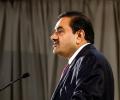
Adani group companies reported a record capital expenditure of Rs 1.53 lakh crore (USD 16.1 billion) and an all-time high EBITDA of Rs 94,834 crore (USD 10 billion) in the 2025-26 fiscal year, signalling an accelerating infrastructure expansion cycle while maintaining leverage below its stated target.

Investments under the framework would remain voluntary for employees.

'Customers do not recover the original making charges paid on old jewellery. Sentimental value is lost when heirlooms are exchanged.'
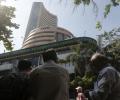
Indian stock market benchmarks, Sensex and Nifty, saw gains in early trading, driven by anticipation surrounding the Reserve Bank of India's monetary policy decision, despite mixed global cues and significant FII outflows.

India and New Zealand are poised to sign a free trade agreement (FTA) on April 27 in New Delhi, aiming to provide tariff-free access for Indian goods to New Zealand's market and attract USD 20 billion in investment over the next 15 years.

Indian benchmark equity indices, Sensex and Nifty, extended their rally for a fifth consecutive session, driven by optimism surrounding a potential US-Iran peace deal and a significant drop in crude oil prices. Despite hawkish remarks from the US Fed, investors remain hopeful that easing energy prices could temper inflationary pressures.

Finance Minister Nirmala Sitharaman on Sunday said individual persons residing outside India (PROI) will be permitted equity investments in listed Indian companies through a portfolio investment scheme.

The Reserve Bank of India (RBI) and the central government have introduced a package of measures, including tax exemptions for FPIs on government securities and a concessional foreign-exchange swap facility, aiming to attract up to $50 billion in foreign capital. This initiative is designed to strengthen India's balance of payments and potentially cover the projected BoP gap for FY27.

Accel and Google's AI Futures Fund have announced the five startups selected for the 2026 Atoms AI Cohort, focusing on enterprise, voice, and industrial AI solutions, with each startup receiving significant investment and resources.

The Indian rupee is highly vulnerable among Asian currencies, with Barclays and MUFG warning of a potential depreciation towards 100/$ if the West Asia conflict persists, driven by widening current account deficits and elevated crude oil prices.

Net investments into equity mutual fund schemes in India remained elevated at approximately 38,440 crore in April, despite a slight dip from March's high and a 3% month-on-month decline in Systematic Investment Plan (SIP) inflows.
